
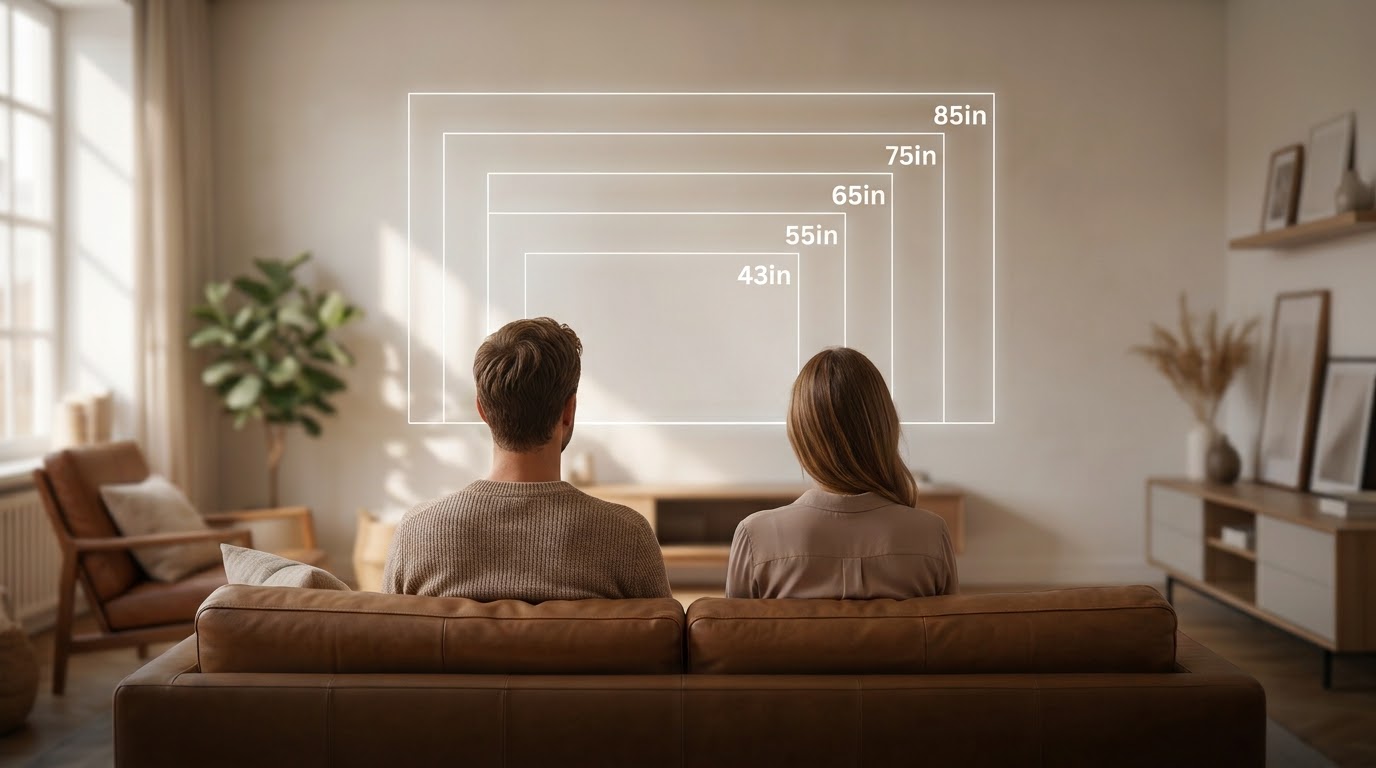
Walking into a big electronics showroom can throw off your sense of scale. Screens look enormous lined up under bright lights. Yet a size that felt “too much” in the shop often looks just right once it’s on your lounge room wall. So if you’re wondering what size TV you need, here’s what I’ve learned fitting TVs across the Northern Beaches and North Shore since 2002.
In fact, in all that time, I can count on one hand the customers who’ve told me they went too big. Going too small is the far more common regret.
A Rough Guide to TV Size vs Viewing Distance
The biggest factor in what size TV you need is how far you sit from it. As a rough guide for a 4K TV, measure from your seat to where the screen will be:
- 1.5 to 2m: 50 to 55 inches, for bedrooms and small units.
- 2 to 2.5m: 55 to 65 inches, for most living rooms.
- 2.5 to 3.2m: 75 to 85 inches, for open-plan living and media rooms.
- 3.2m or more: 85 inches and up, for home theatres and large spaces.
TV makers’ own figures vary. Samsung’s guide, for example, leans bigger. It suggests sitting about 1.2 times the screen size away, which works out to roughly 2m for a 65-inch. So treat this chart as a starting point rather than a strict rule. Personal taste, the room and how the TV sits in the space all matter too.
The TV Size Most People Choose on the Northern Beaches
Numbers on a chart are one thing, but what I see on the job is another. The two sizes I fit most often, by a clear margin, are 55-inch and 65-inch. After that, people tend to jump to a 75-inch, then an 85-inch for bigger living areas. In bedrooms, 43-inch used to be the standard. These days, though, I’m installing a lot more 55-inch TVs in bedrooms too.
Why Wall Mounting Changes the Sizing Decision
A TV on a stand sits forward on the cabinet, a little closer to the couch. Once it’s wall mounted, it sits flat against the wall, so it ends up slightly further away. That’s why, if you’re planning to wall mount, you can usually go one size up from what the chart suggests. In other words, it won’t feel too big once it’s on the wall.
Try the Step Test Before You Buy
Here’s a simple trick I give customers. First, at home, count your steps from where the TV will go to where your head will be on the couch. Then, in the shop, stand in front of the TV you like and walk back the same number of steps. That way, you see the screen from your real viewing distance, rather than from up close in the aisle.
A Few Sizing Mistakes Worth Avoiding
Measuring across the width: TV sizes are measured diagonally, from corner to corner.
Judging the size up close: in a showroom, you usually stand much closer than you’ll sit at home.
Forgetting the wall: a bigger, heavier TV needs fixing into the studs, or the right heavy-duty fixings on brick.
Forgetting the feet: if the TV will sit on its stand, check the feet fit on your cabinet, since they’re often near the edges.
Not Sure What Size TV You Need? Northern Beaches and North Shore Help
If you’d like a second opinion before you buy, send me a photo of the room and the wall, plus the distance to your couch. I’ll tell you what I’d go for. Once the TV arrives, I can wall mount it, hide the cables and set everything up. You’ll find more tips in my 2026 TV buying guide too.
Get in touch through the contact page or send a message to book.