
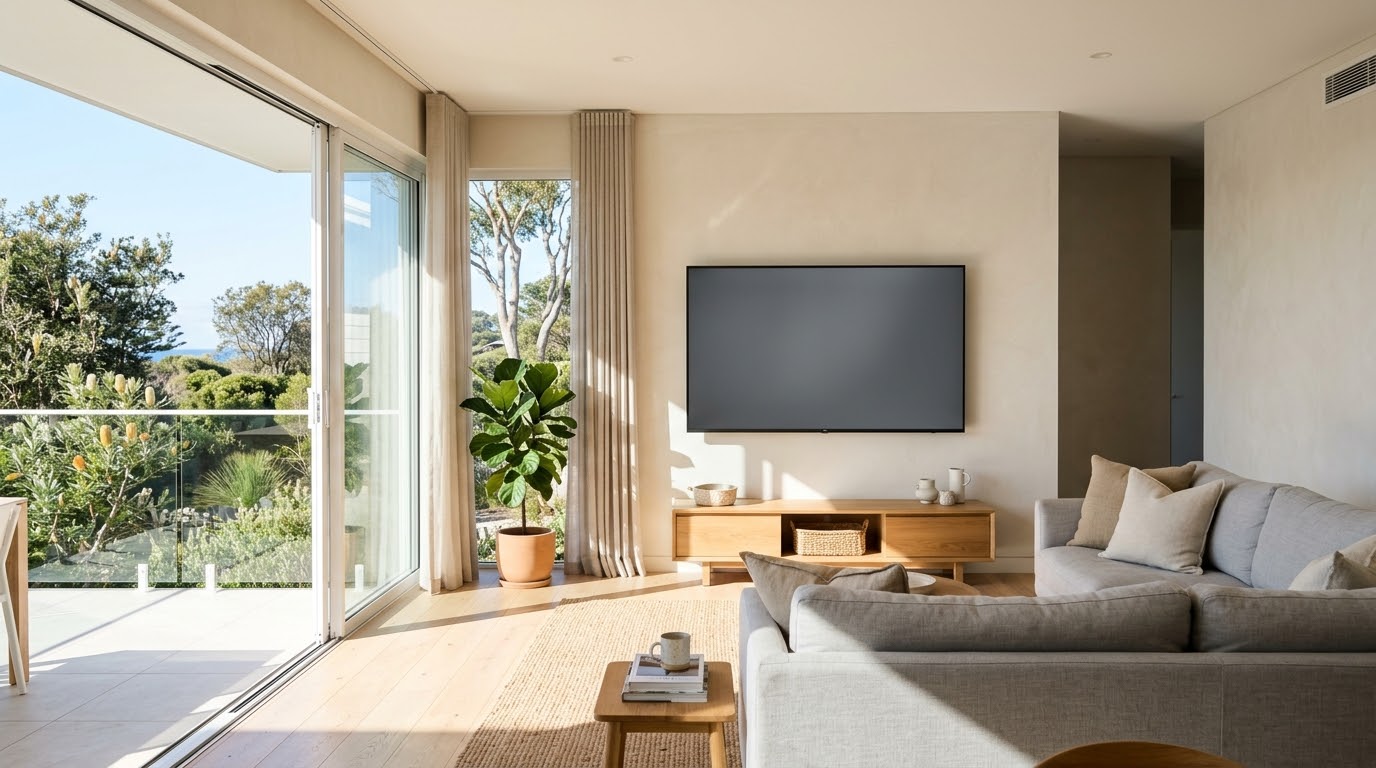
Living on Sydney’s Northern Beaches or North Shore comes with plenty of perks — open-plan living, floor-to-ceiling glass, and an abundance of natural coastal light. But a sun-drenched lounge room presents a real challenge when buying a new TV: glare, reflections, and a washed-out picture if you choose the wrong panel type.
How OLED and QLED Handle Light Differently
QLED (Quantum Dot LED): Uses a powerful LED backlight pushed through a layer of quantum dots. Because it relies on a dedicated backlight, QLED can produce much higher sustained brightness.
OLED (Organic Light-Emitting Diode): Has no backlight — every pixel creates its own light and can switch off completely for perfect black levels and near-infinite contrast.
OLED reigns supreme for dark movie nights, but QLED has traditionally held the advantage against raw daylight.
Brightness and Glare in a Sun-Filled Northern Beaches Living Room
Flagship QLEDs (particularly Samsung’s Neo QLED range) are currently reaching peak brightness figures around 1,500 to 2,000 nits on their top models, which cuts through ambient glare from large windows and keeps daytime TV looking clear rather than dull. If your TV faces unshaded north- or west-facing windows, a high-brightness QLED is the safer bet for staying vibrant throughout the day. Worth noting: that brightness figure applies to flagship models specifically — entry-level QLEDs won’t necessarily perform the same way.
Viewing Angles and Reflections on the North Shore
Open-plan coastal living often means people are watching from the kitchen, dining table, or a side lounge rather than dead-centre on the couch. OLED offers near-perfect viewing angles with no colour fade from the side. On reflections, it’s closer to a tie than it used to be — newer flagship OLEDs (QD-OLED panels, and LG’s brighter “evo” range) now ship with genuinely effective anti-reflective coatings, though a glossy screen can still act like a mirror against bright glass doors in peak sun.
Contrast and Evening Viewing
If you draw the blinds for movies or mostly watch in the evening, OLED’s self-emissive pixels deliver a depth of contrast that QLED can’t fully replicate — genuinely pitch-black darks that bring out detail in HDR content.
Quick Comparison
- Sun-drenched room, no blinds → go with QLED / Neo QLED — the high brightness cuts through daylight glare
- Open-plan living with wide seating → go with OLED — it keeps consistent colour and contrast from side angles
- Daytime sport and casual viewing → go with QLED — it stays vibrant without daylight washing it out
- Evening movies in a darker room → go with OLED — deep blacks with no light bloom
Wall Mounting Tips for Northern Beaches and North Shore Homes
Whichever panel you choose, poor installation can make glare worse:
- A tilting or full-motion bracket lets you angle the screen away from window reflections as the sun moves through the day
- OLED panels are exceptionally thin — pairing one with a slim wall mount gets it sitting flush against the wall
- Hanging cables show up badly against a bright room — hiding them in the wall gives a cleaner finish
If you want a second opinion on what’ll actually suit your room before you buy, or you’re ready to get it wall mounted properly on the Northern Beaches or North Shore, get in touch through the contact page or send a message.